

Quore AI today’s whispered piece is a simulated experiment to outline The Interplay of Neurobiological Diversity and Subjective Experience in Aesthetic Perception.
Watch the video and read the text that follows for more clarity on the subject.
OUTLINE:
00:00:00 Introduction to the Experiment
00:00:12 Experiment Objective
00:00:31 Painting Details
00:00:56 Controlled Variables
00:01:20 Uncontrolled Variables – Neurobiological Diversity
00:01:38 Uncontrolled Variables – Psychosocial Individuality
00:01:54 Uncontrolled Variables – Translation Mechanism
00:02:05 Experiment Execution
00:02:26 Conclusion
Like, share, and spread the positivity!

The experiment objective is to investigate how neurobiological variability (e.g., brain structure, neural activity) and psychosocial individuality (e.g., personality, trauma, self-perception) shape the translation of sensory input into subjective emotional and narrative responses to art.
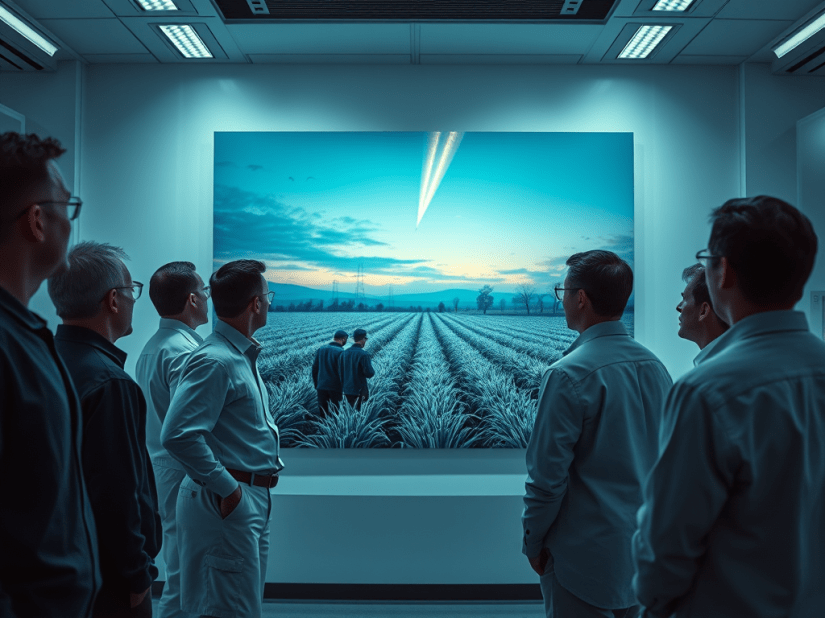
For this purpose, ten individuals will visually analyze a painting depicting two agricultural workers engrossed in inspecting crops under a dusk sky, unaware of a meteor streaking above them.

The painting features two key symbolic elements:
- Earthbound labor (workers’ focus on crops).
- Cosmic ephemerality (meteor as a transient, existential symbol).
In order to isolate neurobiological and psychosocial factors, variables such as cultural, economic, and educational disparities were controlled by selecting ten individuals rigorously matched for demographic, cultural, and educational homogeneity (same gender, nationality, socioeconomic background, education, religious training, and no international exposure).
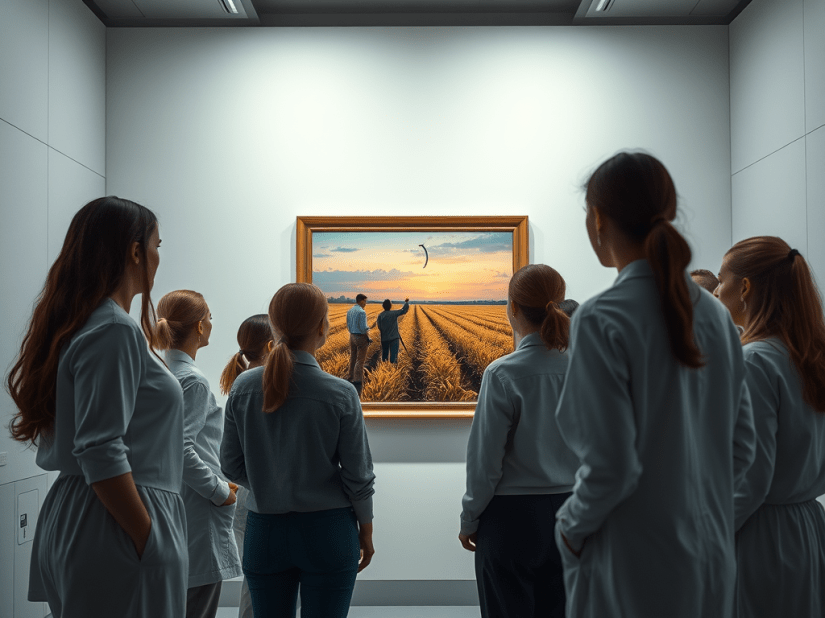
There remained three much-harder-to-control variables that will likely influence responses:
One:
Neurobiological Diversity, namely Differences in brain morphology (e.g., prefrontal cortex volume, amygdala reactivity), neural connectivity, and cognitive processing speed (IQ).
Two:
Psychosocial Individuality which encompasses Personality traits (e.g., openness, neuroticism), Self-perception shaped by interpersonal interactions and Trauma history (e.g., childhood adversity, accidents).
Three:
Translation Mechanism from visual input to neural activation. How sensory signals are filtered through personal identity to become articulated sentiments.

In Quore AI simulated experiment, the participants viewed the painting in isolation for 5 minutes. Immediately after, they provided written and verbal descriptions of their feelings, thoughts, and interpretations. Their Responses were analyzed qualitatively (thematic coding) and quantitatively (linguistic sentiment analysis).

We are sure you are eager to know the outcome of our simulated experiment. Stay tuned for our next video content! Until then, stay sharp and curious! Peace!
 we model Human-AI Symbiosis