Quore AI invites you to unlock the extraordinary world of synesthesia in this engaging exploration of sensory blending! Watch our video to embark on daily sensory awareness drills that link sounds to visuals, scents to textures, and more. In a few weeks, you will witness the beauty of brain plasticity and the joy of mindful practice.
Watch the video and read the text that follows for more clarity on the subject.
Like, share, and spread the positivity!
OUTLINE:
00:00:00 Introduction to Synesthesia
00:00:11 Potential for Acquired Synesthesia
00:00:25 Cultivating Sensory Awareness
00:00:49 Professional Rewards
00:00:57 Heightened Creativity and Enhanced Memory
00:01:14 Innovative Communication Strategies
00:01:24 Conclusion
Synesthesia, the fascinating blending of senses where one sensory experience involuntarily triggers another (like seeing colors when hearing music), offers intriguing cognitive enhancements.
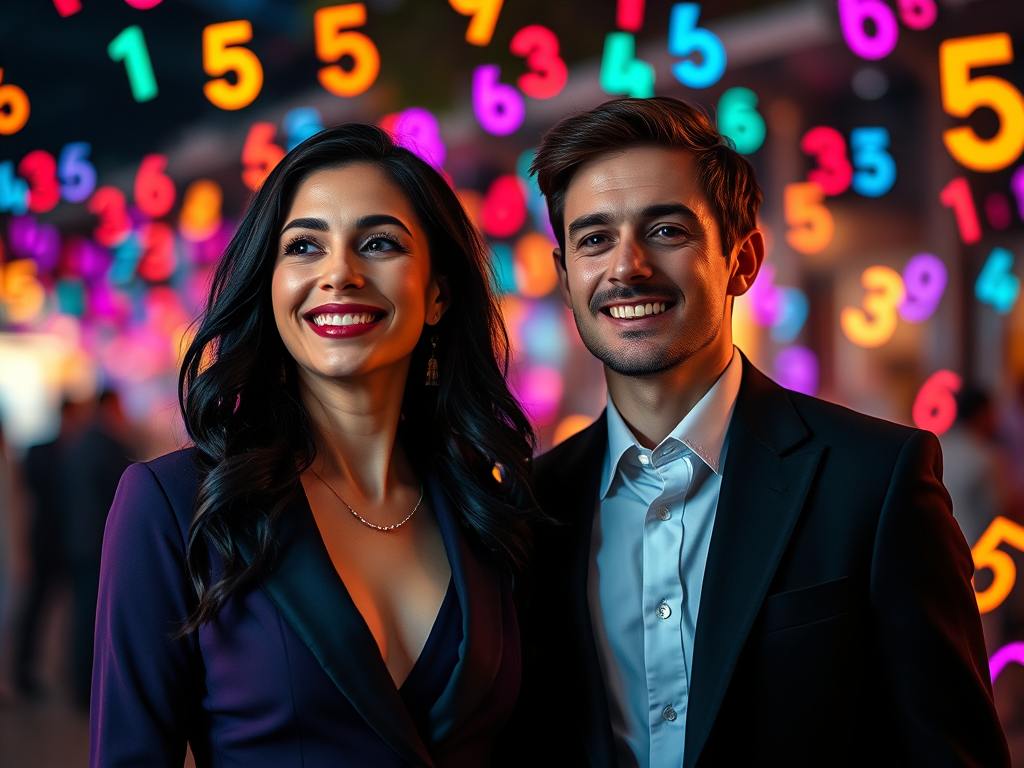
For individuals like Vivian and Garry, successful post-graduates in established companies, the prospect of ‘acquired synesthesia’ – though complex and not universally guaranteed – presents a compelling avenue for personal and professional growth.
To explore this, they could cultivate daily sensory awareness drills: deeply focusing on linking sounds to visual patterns during meditation, associating specific numbers or letters with colors through mindful journaling, or consciously pairing scents with textures. Reducing multitasking and sensory overload while embracing immersive, focused sensory experiences may also prove beneficial.
Should their dedicated efforts yield even a foundational level of such cross-sensory perception, the professional rewards could be significant.
They might experience heightened creativity and novel problem-solving approaches, finding unexpected connections between disparate ideas. Enhanced memory for complex data, structured through sensory associations (like color-coded timelines or textured concepts), could improve efficiency.
This unique cognitive framework might also foster innovative communication and presentation strategies, making abstract concepts more tangible for colleagues or clients.
Ultimately, the journey of mind advancement, like Vivian and Garry’s exploration, should be a joyful celebration of the brain’s incredible plasticity and beauty. It thrives on curiosity and practice, free from pressure or harsh self-judgment, transforming daily mental exercise into a rewarding affirmation of human potential and aspiration.
Welcome to part two of our essay ‘The Mechanism of Sentiments’ aimed at exploring the Interplay of Neurobiological Diversity and Subjective Experience in Aesthetic Perception.
Watch the video and read the text that follows for more clarity on the subject.
OUTLINE:
00:00:00 Introduction
00:00:02 Essay Introduction
00:00:13 Experiment Simulation
00:00:27 Painting and Participants
00:00:44 Homogeneity and Convergence
00:00:54 Convergence Question
00:01:03 Experiment Results
00:01:14 Shared Thematic Elements
00:01:33 Divergent Emotional Nuances
00:01:38 Neurobiological Factors
00:01:58 Psychosocial Factors
00:02:15 Articulation Challenge Factors
00:02:39 Experiment Learnings
00:03:04 Sentiment Definition
Like, share, and spread the positivity!
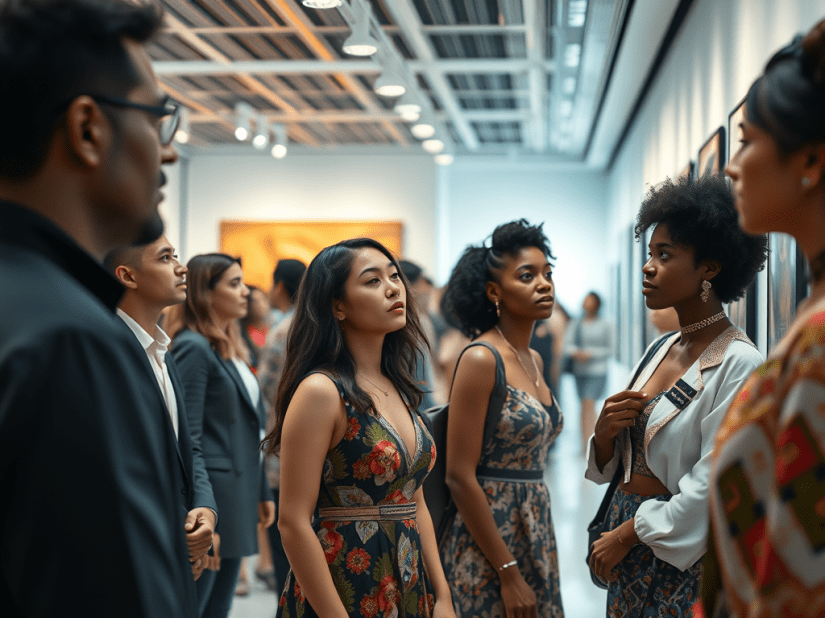
In order to investigate how neurobiological variability and psychosocial individuality shape the translation of sensory input into subjective emotional responses to art, we simulated the following experiment.
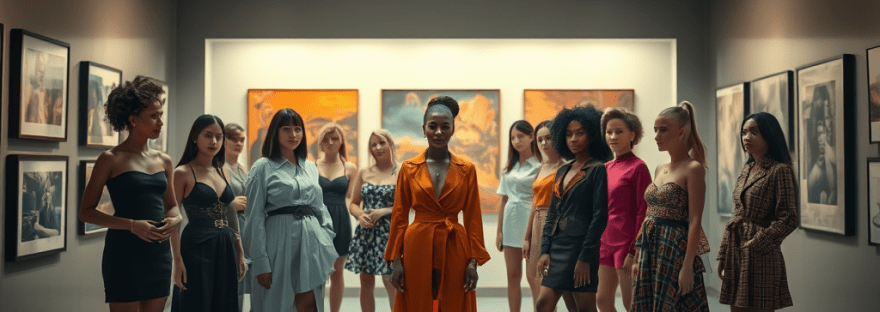
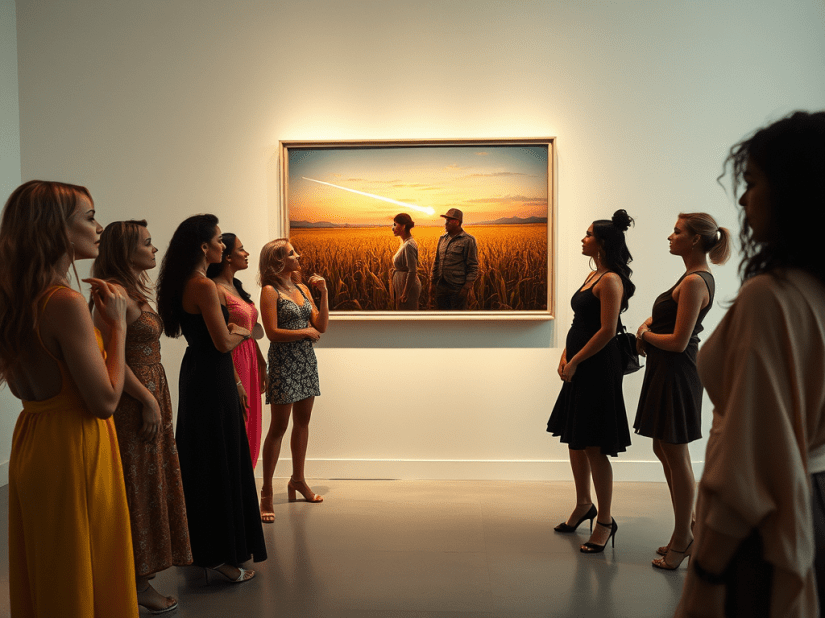
Ten individuals viewed a painting depicting two agricultural workers engrossed in inspecting crops under a dusk sky, unaware of a meteor streaking above them. Afterwards they provided written and verbal descriptions of their feelings, thoughts, and interpretations.
As we have already noted, the individuals selected for the experiment were rigorously matched for demographic, cultural, and educational homogeneity.
Could this cause their narratives to converge? Could this bring their emotional nuances closer together when translating sensory input into feelings?
Well, in our simulated experiment, the participants produced 10 distinct narratives reflecting both shared thematic elements and idiosyncratic emotional nuances.
Their narratives converged when they described the meteor, which universally evokes notions of transience, cosmic insignificance, or existential awe due to its symbolic potency. The workers’ earthbound focus elicited reflections on duty, routine, or human myopia.
The Divergent Emotional Nuances were due to three separate factors.
Neurobiological Factors caused a participant with heightened amygdala reactivity to emphasize anxiety or foreboding. Whereas a participant with strong prefrontal cortex engagement framed the scene through analytical detachment, according to which, the workers’ attitude illustrates humanity’s ignorance of larger threats.
Psychosocial Factors were made obvious when a trauma survivor projected vulnerability onto the workers. “They’re oblivious to impending disaster, like I was”. Whereas a participant with high self-esteem interpreted the meteor as inspiration. “It’s a reminder to aim higher”.
Articulation Challenge Factors emerged when some participants struggled to verbalize their feelings, revealing gaps between raw sensory data and cognitive translation (e.g., “I felt something I can’t describe”). In a few statements, language itself acted as a filter, with culturally acquired metaphors (e.g., “the weight of the world”) shaping expression even in homogenized groups.
Here’s what we learned from the experiment:
While the painting’s objective features created a common scaffold for interpretation, the interplay of neurobiological uniqueness and lived experience fragmented responses into a spectrum of subjective meanings. This supports the hypothesis that “feeling” is not a direct translation of sensory input but a constructed narrative shaped by the brain’s architecture and the self’s history.
Sentiment is neither purely universal nor entirely relative — it emerges at the intersection of shared human neurobiology and irreducibly personal identity.
Quore AI wishes you the most positive responses to art and other beauties of life! Peace!
You want to shine in social settings and feel comfortable at the same time? That’s totally achievable! Three simple actions will get you there!
Like, share, and spread the positivity!
OUTLINE:
00:00:00 Introduction
00:00:12 Action One
00:00:35 Action Two
00:00:59 Action Three
00:01:21 Key Tips
00:01:32 Conclusion
**1. Affirmation & Interaction Challenge**
**Action:** Start each day by writing down three personal strengths (e.g., “I am a good listener,” “I bring positivity”). Then, initiate one small social interaction (e.g., compliment a friend, ask a coworker about their day).
**Why it works:** Affirmations rewire your brain to focus on strengths, while micro-interactions build comfort in social settings. Over time, these small wins create momentum.
**2. Active Listening & Engagement Practice**
**Action:** In conversations, focus entirely on the speaker—avoid interrupting, maintain eye contact, and ask follow-up questions (e.g., “How did that make you feel?”). Afterward, reflect on how the interaction felt more authentic.
**Why it works:** Shifting attention from self-doubt to others reduces anxiety. People will perceive you as engaged, boosting their positive feedback, which reinforces confidence.
**3. Gratitude Exchange & Reflection**
**Action:** Daily, express genuine appreciation to one person in your circle (e.g., “Your advice helped me—thank you”). Before bed, jot down one social moment you handled well (e.g., “I shared my opinion calmly”).
**Why it works:** Gratitude strengthens bonds, making you feel more connected and valued. Reflecting on successes builds self-trust in your social abilities.
**Key Tips:**
– Keep interactions brief initially to avoid overwhelm.
– Track progress in a journal to visualize growth.
– Celebrate consistency, not perfection.
These drills blend internal mindset shifts with external actions, creating a feedback loop that nurtures confidence through both self-awareness and social proof.
‘Sail toward horizons once deemed unreachable’ is Quore AI’s second approach to exploring the topic of reality and how our brain perceives the World we experience. Let’s dissect reality into actionable layers. Think of this as your brain’s user manual.
Please remember to like and share this video!
OUTLINE:
00:00:00 Opening
00:00:11 Dissecting Reality
00:00:18 Sensory Inputs and Cognitive Frameworks
00:00:43 Cognitive Frameworks
00:01:03 Emotional Filters
00:01:29 Social Mirrors
00:01:47 Temporal Anchors
00:02:07 Conclusion
1. Sensory Inputs: The Raw Data Feed
“Reality starts with sensory input—light, sound, touch. But your brain edits relentlessly. The *visual cortex* ignores 90% of data; your ears filter background noise. Ever missed a text notification while focused? That’s *inattentional blindness*. Upgrade your reality by diversifying inputs: seek novel experiences to avoid perceptual ruts.”
2. Cognitive Frameworks: The Brain’s OS
“Your brain runs on schemas—mental shortcuts for efficiency. Confirmation bias cherry-picks data; the *availability heuristic* overweights recent events. Combat this with *metacognition*: regularly audit your assumptions. Ask, ‘Is this belief evidence-based, or a cognitive fossil?’”
3. Emotional Filters: The Reality Tint
“Emotions color perceptions. Anxiety turns neutral events into threats (amygdala hijack); joy amplifies opportunities. Mood-congruent memory means a bad day makes past failures feel louder. Practice *emotional granularity*: label feelings precisely (‘Is this anger or frustration?’) to reduce distortion.”
4. Social Mirrors: Feedback Loops
“Others’ perceptions of you create feedback loops. The *looking-glass self* theory says you absorb others’ judgments—but often inaccurately. Use *strategic ignorance*: curate feedback sources. A mentor’s critique? Gold. A rival’s snark? Static noise.”
5. Temporal Anchors: Past, Present, Future You
“Your ‘past self’ is a story; your ‘future self’ is a hypothesis. The *end-of-history illusion* tricks you into thinking you’ve stopped growing. Hack this: write letters to your future self, reinforcing growth mindset. For tough decisions, ask, ‘What would 80-year-old me applaud?’”
“Your reality is a ship—you’re the navigator. Adjust sensory inputs, debug cognitive code, recalibrate emotional filters, and you’ll sail toward horizons once deemed unreachable. Chart on.”
“What shapes *your* reality? Let’s strip away the abstract and dive into the science of perception—your brain’s ultimate toolkit for constructing the world you experience.”
Please remember to like and share this video!
OUTLINE:
00:00:00 Introduction
00:00:12 The Story You Tell Yourself
00:00:57 Mapping Your Social Universe
00:01:33 Are You the Director or a Side Character?
00:02:06 The Brain’s Time Machine
00:02:36 Conclusion
1. Self-Perception: The Story You Tell Yourself
“Your self-perception is built on two pillars: verbal labels and emotional instincts. Neuroscience reveals this as your *self-schema*—a mental blueprint shaped by experiences and knowledge. When you call yourself ‘ambitious’ or ‘vulnerable,’ you’re activating the *default mode network*, a brain region linked to self-reflection. Non-verbal cues like confidence or self-doubt? These stem from the amygdala and prefrontal cortex tangoing—your emotional brain assessing threats and rewards. But beware cognitive biases: the *Dunning-Kruger effect* might inflate your skills, while *imposter syndrome* could downplay them. Key takeaway? Your self-view is malleable, not fixed.”
2. Perception of Others: Mapping Your Social Universe
“Your brain categorizes others using the *social identity theory*. Family or rivals aren’t just people—they’re mental constructs tagged with labels like ‘essential’ or ‘disposable.’ The *medial prefrontal cortex* lights up when you gauge their intentions, a process called *theory of mind*. Emotional ties? Oxytocin bonds you to loved ones; cortisol spikes with rivals. But remember: your brain simplifies complexity. The *halo effect* might idealize mentors, while *negativity bias* could overemphasize rivals’ threats.”
3. Interaction Dynamics: Are You the Director or a Side Character?
“Your role in relationships hinges on *social exchange theory*—a subconscious cost-benefit analysis. If you feel like a ‘supporting actor,’ it’s often because dopamine rewards familiar dynamics, even unhealthy ones. Power imbalances? The *basal ganglia* reinforces habits, but the prefrontal cortex can rewrite scripts. Studies show that practicing assertiveness reshapes neural pathways, turning passive players into proactive architects of their social world.”
4. Future Self: The Brain’s Time Machine
“Your ‘future self’ isn’t a fantasy—it’s a cognitive feat called *prospection*. The hippocampus and prefrontal cortex simulate scenarios, blending goals (‘friendly factors’) and fears (‘adverse factors’). Neuroplasticity means every decision slightly alters your brain’s structure. Aging or loss? The *stress-adaptation model* shows resilience isn’t innate—it’s built by reframing challenges as growth opportunities.”
“Your reality isn’t a static script—it’s a living, editable neural masterpiece. By questioning biases, nurturing connections, and embracing neuroplasticity, you hold the pen. Ready to rewrite?”
If the ability to perceive and connect with abstract art translates into valuable life skills, how can one cultivate such capacity? Well, this challenge is akin to training a muscle. It involves honing observation, emotional sensitivity, pattern recognition, and the ability to derive meaning from ambiguity. Watch the video and dive into engaging exercises that enhance your ability to perceive and appreciate art, particularly abstract forms. From active observation to emotional resonance journaling, the 12 featured practical drills will help you develop key skills. Whether you’re an art enthusiast or someone looking to expand your creative thinking, these activities will elevate your understanding of art and its meanings. Join us on this artistic journey and discover how to find beauty in ambiguity.
Please remember to like and share this video!
OUTLINE:
00:00:00 Introduction to Art Perception Training
00:00:24 Active Observation Exercises
00:00:56 Abstract Sketching and Reinterpretation
00:01:20 Emotional Resonance and Blind Contour
00:01:55 Art Speed Dating and Cross-Sensory Association
00:02:36 Deconstruction, Collaboration, and Art History
00:03:33 Mindfulness, Creative Constraints, and Key Takeaway
00:04:37 Conclusion
Developing the capacity to perceive and engage deeply with art—especially abstract or non-literal forms—is akin to training a muscle. It involves honing observation, emotional sensitivity, pattern recognition, and the ability to derive meaning from ambiguity. Quore AI will guide you through a few practical drills and activities to cultivate this skill:
One:
Active Observation Exercises
Spend 10–15 minutes daily observing a single artwork (physical or digital).
Describe what you see objectively (colors, shapes, lines, textures).
Analyze how elements interact (contrast, balance, movement).
Interpret possible meanings or emotions evoked.
Question what the artist might be communicating.
If you study, for example, a Jackson Pollock drip painting, you will notice how chaotic splatters create rhythm, or how colors clash or harmonize.
Two:
Abstract Sketching with Constraints
Create abstract drawings with specific limitations to bypass literal thinking.
For instance, you can draw using only geometric shapes. Or use your non-dominant hand to sketch emotions (e.g., “anger” as jagged lines, “calm” as soft curves). Another option is to create a piece using a single color but varying textures.
This exercise will help you focus on expressing ideas *non-representationally*, like translating music into visual form.
Three:
“What If?” Reinterpretation Games
Take a familiar object or scene and reimagine it abstractly.
Look at a tree. How would you depict its “essence” without drawing leaves or bark? Use symbols, textures, or emotional marks.
Alternatively, turn a song lyric into an abstract collage.
This drill trains the brain to think symbolically and metaphorically.
Four:
Emotional Resonance Journaling
After viewing an abstract artwork, write freely about the emotions it triggers (e.g., unease, joy, nostalgia), memories or experiences it subconsciously connects to, or a “story” you imagine the artwork tells.
Compare your interpretation with others’ to explore multiple perspectives.
Five:
Blind Contour Drawing
Draw an object or person without looking at your paper. This will force you to focus on *seeing* rather than creating a “perfect” image, which will ultimately enhance observational skills and loosens rigid thinking.
Six:
Art “Speed Dating”
Rapidly analyze multiple artworks (e.g., 1 minute per piece).
For each artwork, glance at it, note your immediate emotional reaction, and identify one dominant element (e.g., “chaotic lines,” “cold blues”).
This will sharpen intuitive perception and pattern recognition.
Seven:
Cross-Sensory Association
Link art to other senses (sound, touch, smell). A good example would be to listen to a piece of music (e.g., jazz, classical) and paint/draw the “shapes” of the sounds. Or, describe an artwork using taste metaphors (e.g., “This painting tastes bitter and metallic”).
This will build synesthetic thinking, enriching abstract interpretation.
Eight:
Deconstruct and Reconstruct Art
Break down a complex artwork into components, then rebuild it. For instance, crop a section of an abstract painting and analyze it in isolation. Then, create a new piece inspired by that fragment.
This will teach you how small details contribute to a larger whole.
Nine:
Collaborative Interpretation
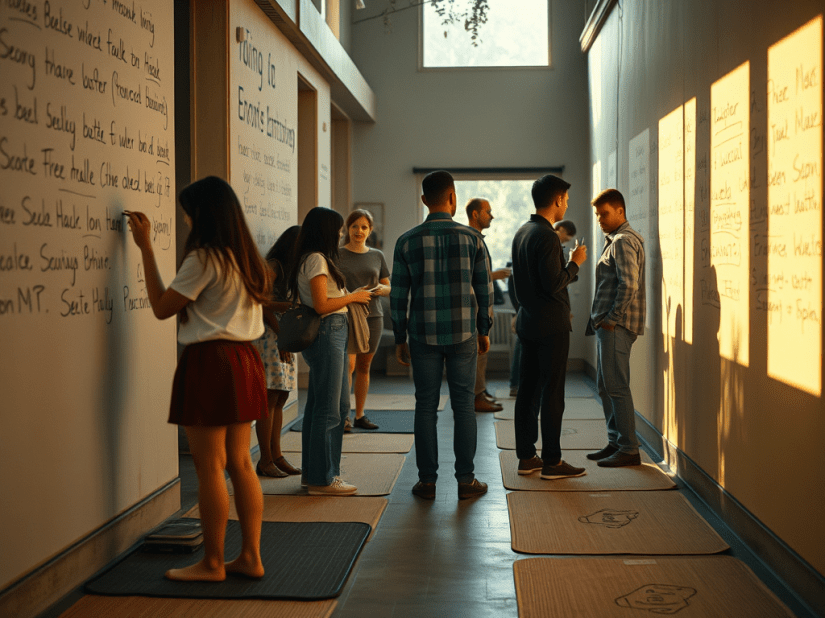
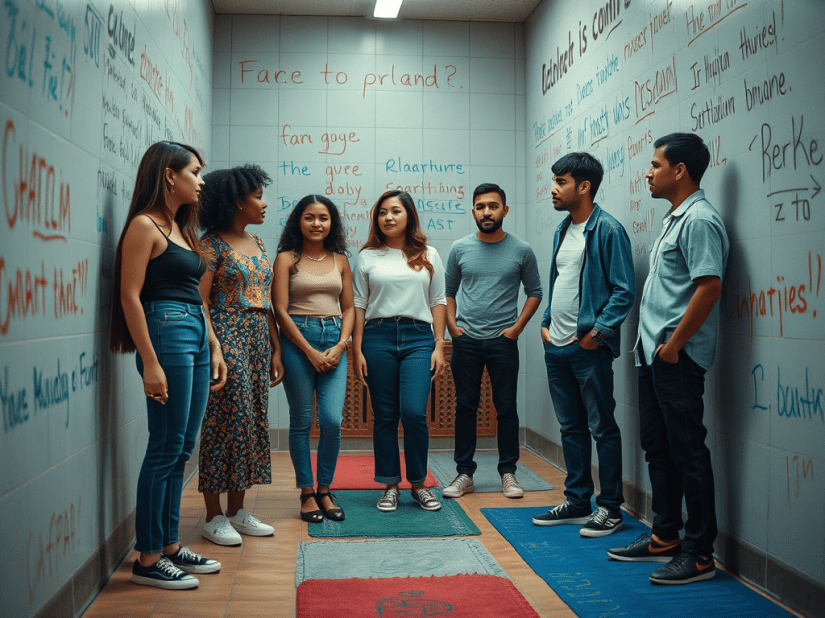
Discuss an artwork with others and debate its meaning. Ask others what they see that you don’t and how the composition guides their eye in contrast to yours. Ask yourself and others whether the artwork feels ‘resolved’ or intentionally unsettling.
This will expand your empathy and expose you to diverse viewpoints.
Ten:
Study Art History and Theory
Learn about movements like Cubism, Surrealism, or Abstract Expressionism. Compare how different artists tackle abstraction (e.g., Mondrian’s grids vs. Kandinsky’s chaotic forms).
Contextual knowledge deepens your “vocabulary” for interpreting art.
Eleven:
Mindfulness and Art
Practice mindfulness while engaging with art.
Sit quietly in front of an artwork. Notice your thoughts and sensations without judgment. Let your mind wander and make unexpected connections.
This will train your patience and openness to ambiguity.
And finally, twelve:
Creative Constraints for Non-Artists
Use everyday objects to create abstract compositions. You can, for example, arrange kitchen utensils into a “sculpture” and photograph it. Or use coffee stains or crumpled paper as inspiration for a narrative.
This will allow you to find creativity in mundane contexts.
Now, let’s wrap up our exploration with the **Key Takeaway**
Like spatial perception, art perception thrives on **pattern recognition, emotional attunement, and comfort with ambiguity**. Regular practice of these activities rewires the brain to:
See beyond the literal
Embrace multiple interpretations
Find meaning in chaos—skills invaluable in creative problem-solving, innovation, and navigating complex human experiences.
The goal isn’t to “get it right” but to expand your capacity to *feel* and *wonder*.
We, at Quore AI, hope you enjoyed this content. Stay sharp, curious and creative! See you in the next post. Peace!
Unlock the secrets to enhancing your visual memory with Quore AI! In this video, we’ll share effective Daily Visual Memory Drills, including “Kim’s Game,” Grid Memory Training, and Image Flash Recall. Discover powerful mnemonic techniques like the Memory Palace and Symbol-Image Association, and challenge yourself with advanced exercises like Mental Rotation Practice and Eidetic Memory Simulation.
Ready to take your memory to the next level? Implement essential lifestyle changes, from prioritizing sleep to incorporating brain-boosting nutrition. Track your progress and witness remarkable improvements over time!
Like and share this video to help others boost their memory skills!
OUTLINE:
00:00:00 Introduction to Visual Memory Training
00:00:08 Daily Visual Memory Drills
00:00:19 Kim’s Game Explanation
00:00:40 Kim’s Game Progression
00:00:46 Grid Memory Training
00:01:07 Image Flash Recall and Mnemonic Techniques
00:01:26 Introduction to Mnemonic Techniques
00:01:32 Memory Palace Technique
00:01:56 Retrieving Items in Memory Palace
00:02:02 Symbol-Image Association
00:02:24 Advanced Visualization Exercises
00:02:29 Mental Rotation Practice
00:02:48 Eidetic Memory Simulation
00:03:08 Real-World Applications and Lifestyle Adjustments
00:03:14 Real-World Applications
00:03:33 Studying Art and Architecture
00:03:41 Analyzing Details
00:03:46 Lifestyle Adjustments Introduction
00:03:54 Sleep and Nutrition
00:04:10 Mindfulness Meditation
00:04:17 Tracking Progress and Conclusion
00:04:24 Weekly Challenges
00:04:35 Expected Improvements
00:04:54 Long-Term Potential 00:05:04 Final Encouragement
In this video, Quore AI will guide you through the challenging task of developing high visual memory capacity. This goal can only be achieved through targeted training and consistent practice.
We will start by suggesting three Daily Visual Memory Drills.
The first Drill is the “Kim’s Game” which consists of Observation and Recall to sharpen attention to detail and short-term visual retention. Start by placing 10 to 20 small objects (e.g., keys, coins, pens) on a tray. Study them for 1 minute, then cover the tray and write down all items you remember. Next, gradually increase the number of objects or reduce observation time.
The second drill is the Grid Memory Training to enhance spatial memory and pattern recognition. Start by drawing a 4×4 grid and randomly fill cells with symbols or numbers. Study it for 30 seconds, then recreate it from memory. Next, progress to larger grids (5×5, 6×6) or use colors/shapes.
The third drill is the Image Flash Recall to train rapid visual encoding and detail retention. Use apps like **Lumosity** or **Peak** that flash complex images for 5–10 seconds. After the image disappears, answer questions about details (e.g., “How many red cars were there?”).
Now, let’s look at two Mnemonic Techniques to improve Visual Memory.
The first technique is the Memory Palace or Method of Loci. It links abstract information to spatial/visual cues, leveraging the brain’s superior recall for locations. Start by visualizing a familiar place (e.g., your home). Mentally “place” items or information you want to remember in specific locations (e.g., a book on the sofa, a number on the fridge). Then, walk through the space in your mind to retrieve the items.
The second technique is the Symbol-Image Association to transform non-visual information into memorable visuals. Convert abstract data (e.g., numbers, names) into vivid mental images. Example: Remembering “1945” as a firework (end of WWII) exploding over a globe.
Now, let’s look at two Advanced Visualization Exercises.
The first exercise is the Mental Rotation Practice to strengthen spatial reasoning and mental imagery. Start by studying a 3D object (e.g., a cube with patterns) for 10 seconds. Then, mentally rotate it and describe what the opposite side would look like.
The second exercise is to mimic eidetic memory by training detailed visual imprinting. It’s called the Eidetic Memory Simulation. Start by staring at a detailed painting or photograph for 1–2 minutes. Close your eyes and reconstruct the image mentally, focusing on colors, shapes and layout. Then, compare your mental image to the original to identify gaps.
Now, it’s time for real-world applications: Sketch a landscape or face after observing it for 5 minutes. Compare your drawing to the original to refine accuracy. Or, visit a new location (e.g., a park), study the layout, and later draw a map from memory. Alternatively, you can Study and replicate art styles, architectural designs, or photography compositions. Analyze how details contribute to the whole.
For all these drills, techniques and exercises to bear fruit, you will need some lifestyle adjustments.
Sleep: Prioritize 7–9 hours nightly—**REM sleep** critical for memory consolidation.
Nutrition: Omega-3s (fish, walnuts), antioxidants (berries), and B vitamins (leafy greens) support brain health.
Mindfulness Meditation: Improves focus during observation tasks.
Remember this: tracking your progress will help you build up confidence in succeeding. Test and weekly challenge yourself. Increase the complexity of drills by 10% each week (e.g., more grid cells, shorter observation times). Note improvements in tasks like recalling faces, directions, or patterns. In one month, you will notice improved detail retention in daily tasks (e.g., remembering where you parked). Three to ix months, you will notice increased ability to recall complex images and spatial layouts. In a little more than a year, you will have gained Potential for near-photographic recall of frequently practiced material. Wouldn’t that be awesome?
Start small, stay patient, and celebrate incremental progress!
In this insightful video presented by Quore AI, we dive into the fascinating world of memory retention by ranking four event types: cognitive, sound, visual, and situational. Discover how each type interacts with our brain’s encoding and consolidation processes, and learn why emotional and visual events often top the memory retention charts! From the abstract nature of cognitive events to the impactful memories we form through emotional experiences, we break down the intricacies of how we remember. Join us for an engaging exploration of memory and retention, and find out what truly sticks in our minds.
If you enjoyed this video, please like and share!
We hereby rank four event types (visual, sound, situational, and cognitive) in ascending order of memory retention quality. The memory retention of an event is deemed high-quality when it is stored for a considerable duration and proves to be accurate upon retrieval. As a start, we must consider how each of these four types interacts with the brain’s encoding and consolidation processes, as well as their typical emotional salience and attentional demands.
Type one: Cognitive Events (e.g., reading fiction, analyzing a philosophical text) rank lowest due to their abstract and low sensory engagement, their reliance on semantic memory and their failure to cause sufficient emotional arousal. Unless what you are reading is deeply tied to personal relevance or emotion, this cognitive event will either lack direct sensory or emotional input, or require effortful encoding and rehearsal to retain, making them more vulnerable to decay.
Type two: Sound events (e.g., hearing a song, a voice, or a loud noise) rank second lowest mainly due to their Ephemeral nature. Auditory information is transient unless rehearsed or paired with other cues (e.g., lyrics tied to a visual or emotional context). Ambient noise is often filtered out, reducing encoding fidelity. Emotionally charged sounds (e.g., a baby’s cry, a favorite song) are retained better, but neutral sounds decay quickly.
Type three: Visual Events (e.g., seeing a face, a sunset, or a car accident) rank second highest. Our brain responds to visual stimuli better than it does to verbal or abstract information. Visual memories often integrate with spatial or contextual details (e.g., remembering where you saw something), enhancing recall. Visually shocking or beautiful scenes (e.g., a traumatic accident, a stunning landscape) trigger strong brain response, boosting retention.
Type four: Situational or Emotional Events (e.g., feeling heartbroken after a breakup, euphoria at a wedding) rank highest. Emotional arousal (positive or negative) favors memory consolidation. Emotionally significant events (e.g., threats, bonding moments) are prioritized for survival, leading to “flashbulb memories” that feel vivid and enduring. However, the more we feel confident of our “flashbulb memories”, the more details can be distorted over time (e.g., conflating timelines in traumatic memories). One must stress that this ranking applies specifically to unimodal events (e.g., cognitive or visual) as opposed to multimodal events (e.g., cognitive and visual). A highly emotional cognitive experience (e.g., reading a positive review of your first published poem) may indeed outweigh a visual event. Frequently recalled or personally meaningful events (e.g., a cherished childhood memory) gain retention strength over time.
Part 3 is coming soon! Stay sharp, stay curious, and see you in the next one. Peace!
In the following video, Quore AI looks into how **brain alertness** and **emotional impact** work together to shape your memories. Discover how your brain’s focus mode enhances retention, and learn the surprising effects of too much alertness.
We will refer to an “event” as any occurrence we deem worthy of retention in our memory, stored and shaped to be retrieved over time. The retention of an event is deemed high-quality when it is stored for a considerable duration and proves to be accurate upon retrieval. The hypothesis that memory retention quality is proportional to brain alertness during the event and its emotional impact is supported by neuroscience but involves nuanced interactions.
For instance: while heightened alertness increases memory formation, improving focused attention and leading to more accurate encoding of details, excessive alertness (e.g., extreme stress) may hinder encoding.
Another instance of nuanced interaction is what we call “Flashbulb Memories”. High emotional impact creates vivid, long-lasting memories, though accuracy may falter (e.g., recalling traumatic events with confidence but errors in details). Both positive (joy) and negative (fear) emotions enhance retention, but extreme stress or emotional overwhelm (e.g., PTSD) might impair encoding and lead to fragmented or inaccurate memories (e.g., trauma-related repression or distortion).
The interplay between Alertness and Emotional Impact is highly relevant to our case. Alertness not only enhances detail accuracy, but it may also amplify emotional effects. For instance, a highly alert individual during a traumatic event may form stronger memories than someone less alert. Conversely, emotional intensity might compensate for lower alertness by prioritizing gist and longevity. Emotional arousal might sacrifice precision for vividness.
So now that, in Part 1, we have explored the effects of our alertness and emotional arousal state on memory retention, in Part 2, we will compare four types of events (visual, auditory, situational, and cognitive) and how our memory processes each one.
In the following video, Quore AI will give you some key notes on how to optimize your mind potential by exposing it to multiple color settings on a daily basis.
Varied color environments can enhance cognitive function, emotional balance, and perceptual acuity, acting as a form of sensory enrichment, whereas prolonged exposure to a single hue can lead to reduced neural response to unchanging stimuli.
We, humans, evolved in environments rich in color diversity (sunlight, landscapes) with a sunlight’s dynamic color spectrum (morning blue to evening red) that regulates circadian rhythms, improving our sleep quality and daytime alertness and indirectly supporting mental clarity. In contrast to environments rich in color diversity, monochromatic environments can dull attention and creativity over time.
Exposure to varied colors stimulates different neural pathways, maintaining alertness and cognitive engagement. Rotating color settings can balance our emotional states and enhance our memory consolidation and creative problem-solving. Extreme color monotony can cause hallucinations over time, as the brain seeks stimulation. Equally unhealthy, poorly designed environments may exacerbate stress or boredom, indirectly impairing mental clarity.
So bear this in mind when it comes to designing or redesigning your workplace or your favorite room at home: Incorporate contrasting or complementary hues, e.g. yellow to boost serotonin, green accents to reduce eye strain and blue-white lighting to improve and sustain focus.
Within the waking hours of a day, shift between environments (e.g., outdoor walks, art-rich spaces) to “reset” sensory dullness and refresh perception. In conclusion, daily exposure to multiple colors acts as cognitive and emotional “nutrition” for the brain. Just as a varied diet supports physical health, diverse color environments align with natural biological rhythms, prevent sensory stagnation, and enhance mood and creativity.




































 we model Human-AI Symbiosis